 |
Telescopes from Afar
An international
conference
on
remotely operated, automated,
or ground based telescopes
Waikaloa Beach Marriott
North of Kona,
Big Island of Hawai'i
February 28-March 3, 2011 |
Conference
Schedule & Events
Click here |
Program & Local
Organizing
Committees
Click here |
Conference completed |
Venue,
Travel, and
Lodging
Click here |
Visiting
Maunakea Observatories
Click here |
Conference Wrap-up
coming soon
|
Canada France Hawaii
Telescope
Conference Website -
Click here |
Chair
Sarah Gajardhar, Canada France Hawaii Telescope
Cochairs
Russell Genet, California Polytechnic State University
Josh Walawender, University of Hawaii
Fully
robotic observatories have been in continuous
operation for a quarter century. Although initially
confined to smaller telescopes, many large
observatories are now being operated remotely and
even autonomously without staff on-site.
The
goal of this conference is to provide an opportunity
to share information on the advancements and
developments in the areas of remote observing,
remote operation, and automated local and global
networking of all sizes of observatories. The
conference will explore management, operational, and
engineering considerations. Participants will
exchange ideas and experiences with designing and
operating robotic observatories and retrofitting
existing observatories for remote and autonomous
operations.
The
topics for the sessions will be influenced by the
abstracts that are submitted; however, we envision
the subjects may include:
-
History and overview
-
Economics and motivation
-
Examples of robotic observatories
-
Examples of retrofitting existing observatories
for remote operation
-
Target selection, scheduling and queue observing
-
Event alerting and telescope networks
-
Data handling, reduction, and verification
-
Instrumentation
-
Monitoring and control of observatory systems
-
Weather and environmental sensing
-
Safety
The
members of the CFHT staff, along with members of the
Maunakea astronomical community, look forward to
welcoming you to Hawaii and sharing with you the
many aspects of this advancement in astronomical
observations.
Aloha,
The
Program Organizing Committee
Canada-France-Hawaii Telescope (CFHT)
Big Island, Hawai'i
Program Organizing Committee
Andy Adamson, Gemini Observatory
Sarah Gajadhar, Chair, Canada-France-Hawaii
Telescope
Russel Genet, Co-chair, California Polytechnic State
University
John Martinez, Las Cumbres Observatory Global
Telescope
Christian Veillet, Canada-France-Hawaii Telescope
Josh Walawender, Co-chair, University of Hawaii,
Institute for Astronomy
The POC can be contacted by email at
tfapoc@cfht.hawaii.edu
Local
Organizing Committee
Moani Akana, Canada-France-Hawaii Telescope
Ferdinand Babas, Canada-France-Hawaii Telescope
Sarah Gajadhar, Canada-France-Hawaii Telescope
Mercedes Stevens, Canada-France-Hawaii Telescope
Christian Veillet, Canada-France-Hawaii Telescope
Josh Walawender, University of Hawaii, Institute for
Astronomy
Back to Top
Conference Schedule and
Events
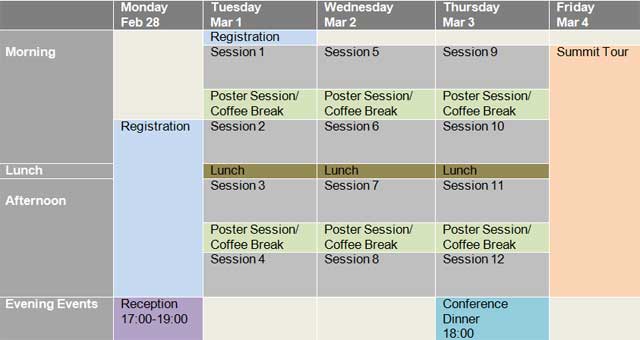
Reception
A
welcome reception is scheduled for Monday, 28
February, and will take place on the grounds of the
Ball Room terrace from 5:00 to 7:00pm. During this
time, "pupus" (or apperitives) from the islands will
be served. Upon registering, you will receive two
tickets for drinks for this occasion, after which a
no-host bar will be available. Participants may
bring guests for the reception for an additional
fee. Please indicate if you will be bringing guests
on your registration form.
Note: The Registration Desk will be open from 2:00pm
until 7:00pm, Monday 28 February. It will reopen on
Tuesday, at 7:00am.
Conference Dinner
The
conference dinner will take place on the Luau
Grounds of the hotel, on Thursday, 3 March, at 6pm.
This event will be held outdoors and will feature
the unique gastronomy spread of a "luau". Music from
the islands and an open bar for 2 hours will be part
of the evening. Please let us know if you and your
guests will be joining us for this dinner on your
registration form.
Summit
Tour
As part
of the conference activities, a visit of the CFHT
observatory, and possibly other observatories on
Maunakea, is scheduled for Friday, 4 March. The
schedule for this event is anticipated to start
9:00am with an estimated return to the hotel at
3:00pm. Transportation and lunch at Hale Pohaku, the
Mid-Level facility, will be provided.
As space is limited for this tour, each participant
may register up to one guest who is 16 years of age
or over. Please indicate if you will attend this
tour on your registration form.
The following website will introduce you to the
astronomical community on Maunakea, and provide you
some necessary information prior to your trip to
Maunakea.
Visiting Maunakea Observatories
|